N Kolay's Digital Route from Bill Collection to Open Banking
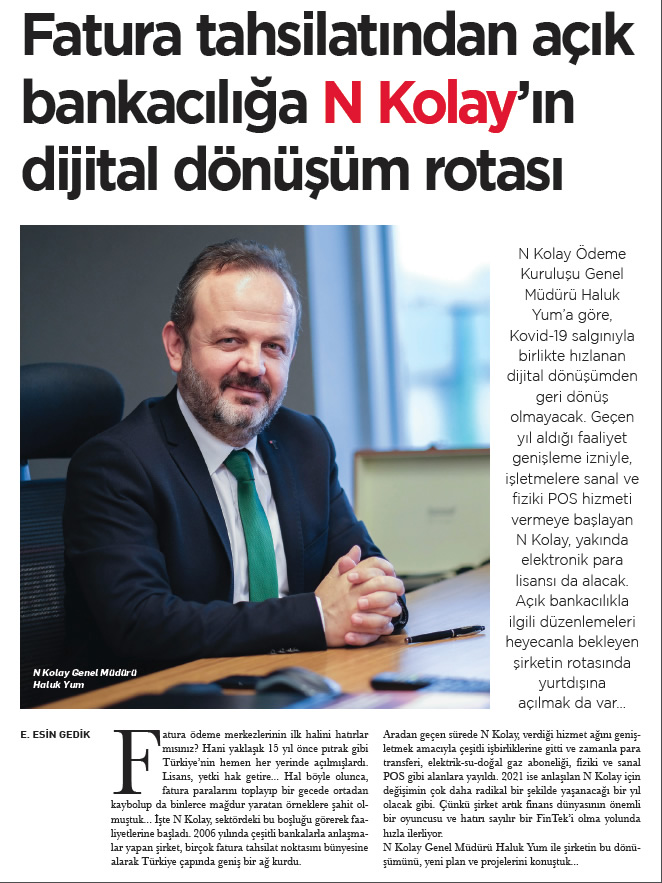
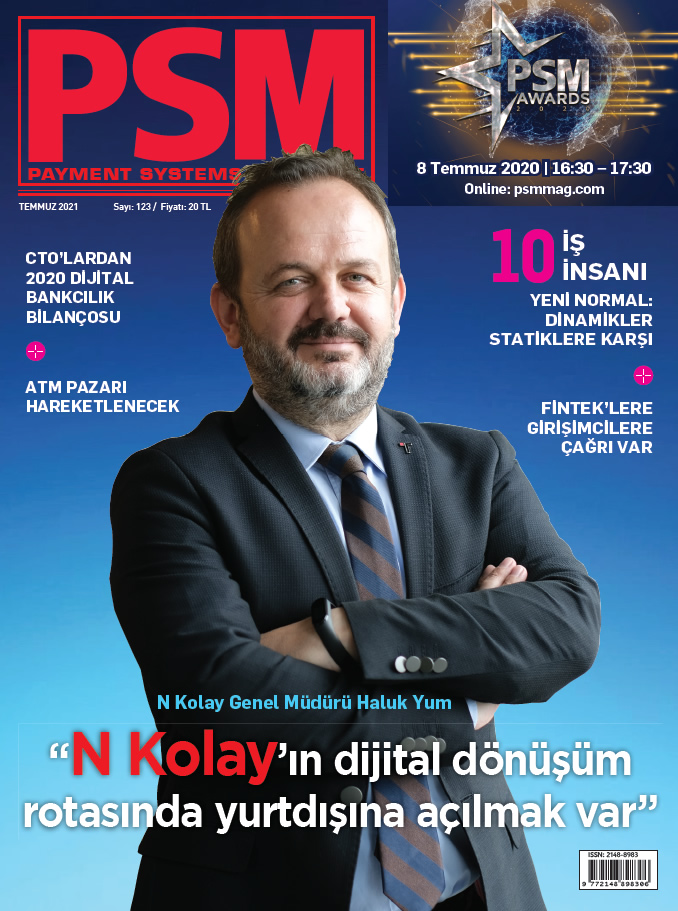
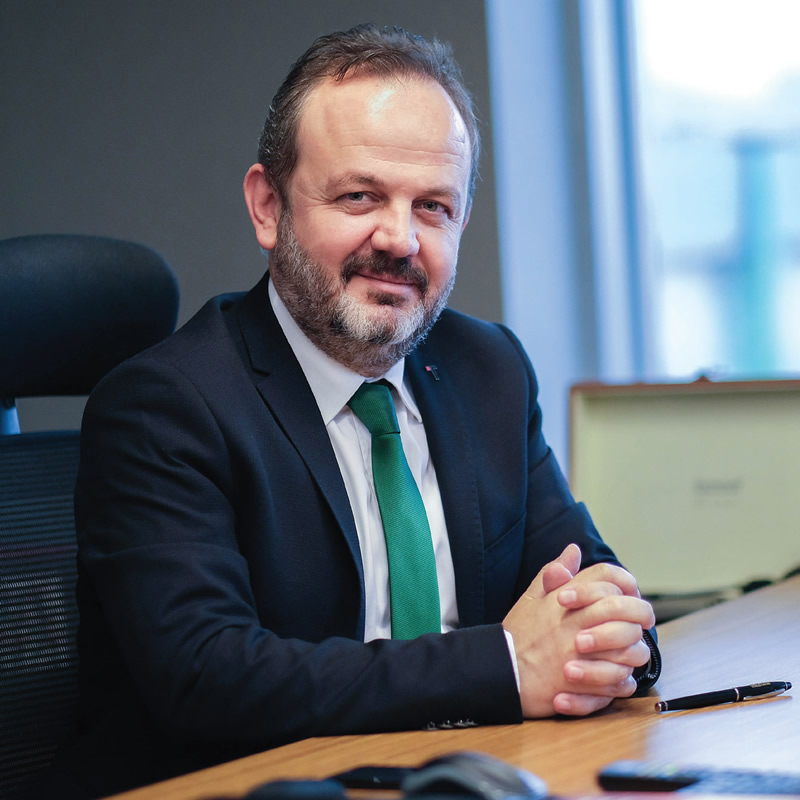 N Kolay General Manager Haluk Yum
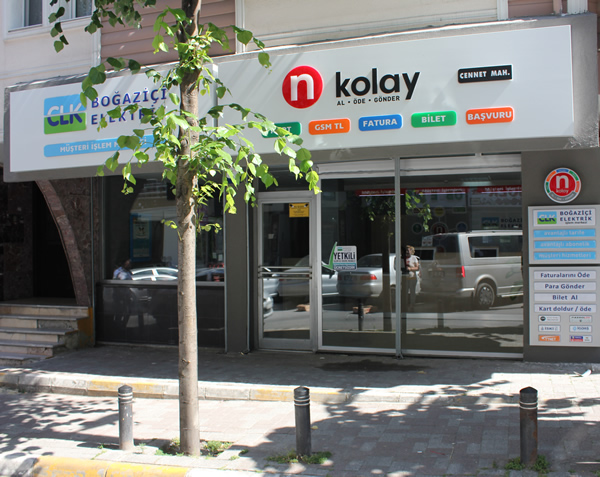 N Kolay Bill Payment Point
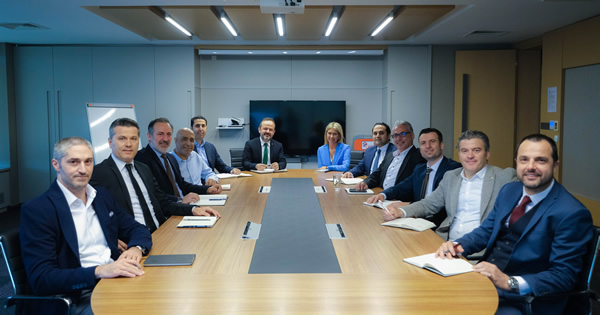 N Kolay Payment and Electronic Money Institution
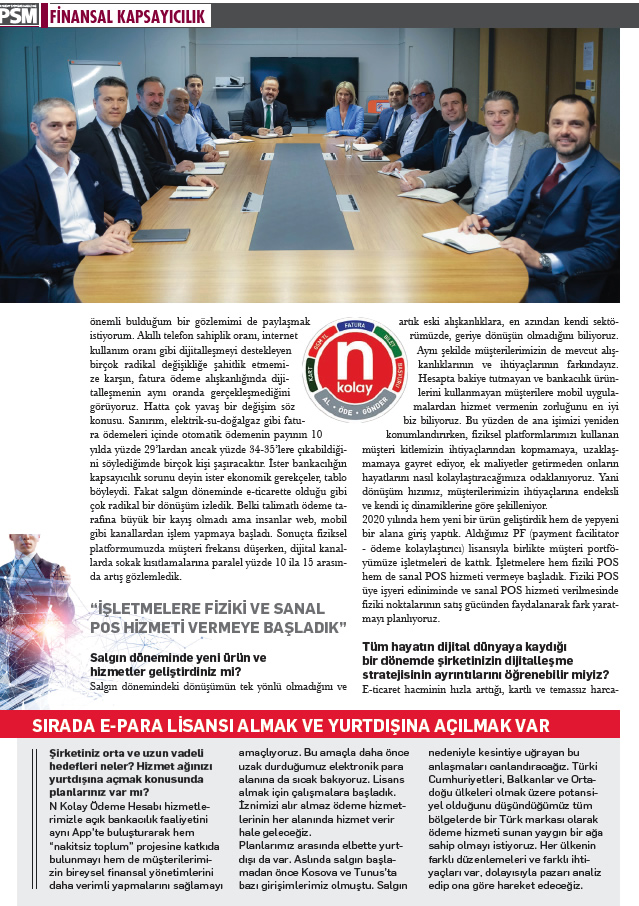
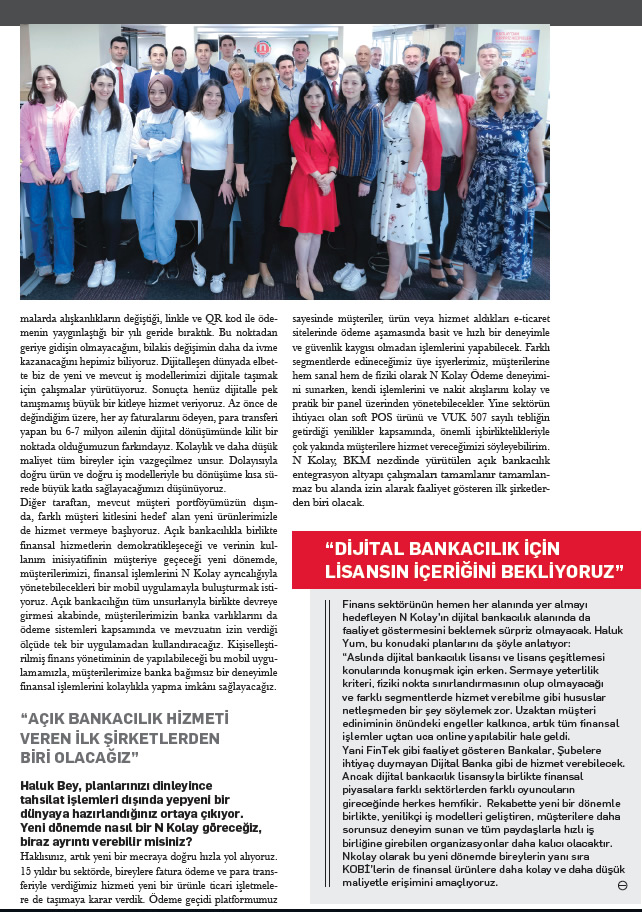
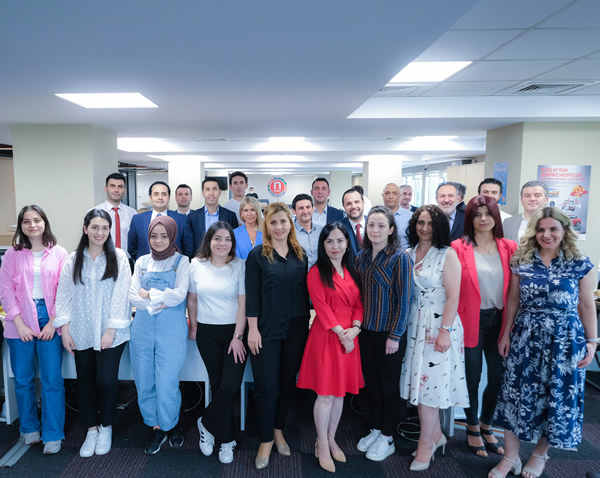 A small snapshot from our big N Kolay family
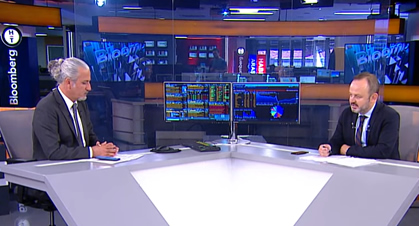
As far as we know, Nkolay is the Payment Institution with the most widespread physical network in Turkey. How has the digital transformation accelerated by the pandemic affected Nkolay, and can we learn about Nkolay's digitalisation strategy?
With services at over 13,000 physical points, we are Turkey's most widespread payment institution. Actually, not just the most widespread network, but also one of the oldest companies in this sector.
Before moving on to digitalisation, it would be useful to talk a little about our current structure. We have been providing services in the payment systems sector since 2007, we are one of the first companies to receive an operating licence under Law No. 6493 on Payment Services, and we have considerably increased our product category by adding new products every year on this path we started with bill collection mediation.
We serve 8 million customers, the majority of whom are not bank customers or rarely use the banking system, and 5 million of these customers come to our offices almost every month.
Despite growing in transaction volume every year until the pandemic, I can say that for the first time last year we were unable to achieve an increase in transaction volume per point.
As I mentioned earlier, the vast majority of our customers are an audience that the banking system cannot reach, and therefore an audience that has not yet met digital products. That's why we are aware that we are in a very important position in the context of the transition to a cashless society and digitalisation. Our greatest advantage here is that we know our customers very well, we know exactly what they need and the missing pieces in the digitalisation process. Therefore, we plan to continue this process that started with the pandemic and to be part of our audience's transformation process in the coming period.
The second important point is that, again last year, with the lockdown restrictions and the decrease in customer frequency coming to receive services in line with the course of the pandemic, we increased third-party collaborations. We saw that we could provide services in this channel to a bank that closed its branch or to financial institutions that do not have a physical channel, to other stakeholders. This is both a need of our customers and a demand from other parties who want to reach customers.
With open banking coming into effect next year, we think that this physical platform we mentioned will have a very important role in this sense.
From what I understand about the digitalisation you mentioned, open banking will also have an important role. What is your approach in the field of open banking? In a sector that is taking on a new face with regulations, what kind of understanding will you act with in this new era?
The area where we will feel open banking most intensely is undoubtedly the world of Payment Systems. Until now, an account-holding customer could only make transactions through the financial institution where the account was opened, but with open banking, the customer can, if they wish, monitor the account opened at one institution through another financial institution, and even initiate payment orders and carry out financial transactions. Naturally, this opportunity can provide significant advantages to platform owners, whether digital or physical, to channels that have closer contact with customers. Of course, it should not be forgotten here that with open banking, customer satisfaction will come to the fore much more, and products that exactly match customer needs will be decisive.
How do you see the relationship between Fintech startups and Banks in the near future, specifically for Payment and Electronic Money institutions?
In 2015, when the concept of Fintech started to be used, it was widely discussed that these structures could be a threat to Banks. But at this point, we see that the final decision is made by the regulatory/supervisory authority, and today we witness that collaboration with Banks is much more on the agenda. As Nkolay, our parent company Aktif Bank has already stepped into the fintech world with both Nkolay and 2 separate companies (along with UPT, which is Turkey's first money transfer company), and we see that many Banks have recently entered the Fintech ecosystem through acquisitions or new formations. Therefore, in the coming period, we see that collaborations will increase, deepen and become widespread as a business culture, more towards expanding inclusivity, in a sense enlarging the pie, rather than a conflict over share of the pie.
On the other hand, the technological superiority and product diversity of the Banking system in our country compared to other countries is evident. The Fintech sector actually took this as its foundation and benefited greatly from this situation. Similarly, the Banking sector has recently shown that it can compete with fintechs in agility, and has pioneered opening up to the outside world with APIs and providing services to platforms. So we have already started to see the positive results of the interaction between the 2 sectors.
At the beginning of this year, you entered the PF business by obtaining an operational expansion permit from TCMB. Can we learn about your goals for the virtual POS world?
Taking the payment mediation services we have been providing to households for years to tradespeople and commercial life has been a plan we have had for a long time.
As you know, both the retail sector and companies doing B2B business moved commerce to the digital environment at a speed far beyond expectations. In this case, both companies and financial institutions focused on digital payment systems. E-commerce covered in the last 1.5-2 years the distance it would have covered in 6-7 years. For example, in 2020, e-commerce reached the TRY 230 billion limit with a record increase of 66%.
The situation in Virtual POS is not different, in fact the growth there is even faster. Last year TRY 260 billion worth of commerce took place through Virtual POS, of which approximately TRY 130 billion was from e-commerce. We can better understand the growth trend in Virtual POS with the following example: while the total physical POS volume was approximately TRY 480 billion in 2015, it reached TRY 910 billion in 2020, almost doubling, whereas in the same period the Virtual POS volume increased 5 times.
Our expectation within the next 5 years is that e-commerce will reach TRY 650-700 billion annually, and Virtual POS + other alternative digital payment methods will push towards the TRY 900 billion band, also with the effect of B2Bs.
At this point it is useful to clarify for viewers. If a business wants to use Virtual POS, they either have to integrate directly with each Bank individually and make a separate agreement with each of them, or they can easily start providing services through us, i.e. through PFs. Currently 13% of the total volume takes place through PFs and this rate is rapidly increasing. This is a more reasonable and less costly method especially for the SME segment. That is why we expect the Virtual POS volume of PFs, which currently reach TRY 40 billion annually, to reach the TRY 175-200 billion range within 5 years.
As NKolay, we have also started providing merchant services to commercial businesses by developing our Nkolay Panel, both to be in this growing sector and to be able to mediate many needs of small and medium-sized businesses, in a sense to be an SME Fintech.
From what I understand, you will also offer different services to SMEs along with Virtual POS?
Thanks to our long-standing work with our Representatives, each of whom is actually an SME, we have had the chance to observe what commercial businesses struggle with and what they need in the field. We wanted our member merchants to manage their own transactions and cash flows through an easy and practical panel while offering both virtual and physical NKolay payment experience to their customers. That is, we wanted them to manage all their accounts from a single panel, have accounting integration, and access many services from this panel.
One of the biggest problems of SMEs is either the inability to grow efficiently due to difficulty in accessing financing or borrowing at high costs by making wrong choices. In this regard, we wanted to collaborate with as many banks and financial institutions as possible, include them all on the same panel, and enable member merchants to access financing through the channel they prefer. For example, we read that 30-35% of businesses in the USA access financing through Fintechs. Similarly, we will enable companies from every segment we serve to easily access Banking products and contribute to the spreading of financing to the base.
At the same time, through collaborations we will make with third parties, we will also include their products on this platform. Payroll, incentive consulting, e-commerce training are some of them.
In summary; we have decided to take the service we have been providing to our individual customers for 15 years to commercial customers with the product I have described, and we hope this will contribute greatly to businesses.
BDDK opened the digital banking regulation for consultation. What do you think about this? As an institution that mainly provides services from physical points, how do you foresee this development will affect you?
Before that, it is useful to talk about remote identity verification, which is a giant step in the process of digitalising existing Banking. As you know, our Banks had digitalised their financial products, especially individual banking products, a long time ago. The only problem in this chain was the "wet signature in customer acquisition." In recent months, BDDK put into effect the communiqué on remote identity verification in new customer acquisition, allowing the entire process to be digitalised. In a sense, BDDK both eliminated a matter that could be an obstacle to the process before the Digital Banking Licence and prevented possible unfair competition for the existing Banking system in advance.
The Digital Banking Licence first officially became recognised in the Economic Reform Package in March of this year, and last month the Draft Regulation was published and submitted for the opinion of the public/parties. As is known, Fintechs in Europe provided digital banking services by obtaining a classic Banking licence, while in Asia digital banking appeared as a separate licensing and naturally had some product and service limitations. A similar path to Asia was followed in our country; according to the Draft, it was limited to the Individual and SME segments in the first phase. While there is no limit on deposit-taking, limits have been set especially for loan amounts that can be given to consumers.
Well, what will this new Banking bring for customers? Since organisations with a digital banking licence will have lower operating costs compared to traditional banks, if they pass this cost advantage on to consumers, competition will increase and consumers may become more advantaged compared to the current situation. Similarly, households' access to banking services will become much easier.
Service Model Banking, which was published together with the Digital Banking Draft Regulation, excited the sector at least as much as digital banking. In a sense, in this process initiated with the first step of Open Banking, consumers will be able to access financial products at the moment of need without directly contacting Banks / going to the Bank.
In the near future, the Regulations will undoubtedly take their final form and come into effect. Together we will see both new players and new collaborations in the sector; the process will certainly have winners and losers, but ultimately there will undoubtedly be important advantages/gains for consumers.
While Aktif Bank operates as a huge financial technologies ecosystem, it is also a bank very open to collaborations and partnerships with different institutions. As an Aktif Bank affiliate, you also act with this understanding and collaborate with various organisations. Can you talk about existing collaborations and new collaborations you plan for the upcoming period?
Aktif Bank is a bank that has pioneered the sector with both nkolay and domestic first money transfer companies like UPT, and its working culture is almost entirely based on partnerships and collaborations. As far as I can see, it is ingrained in our group's genes. Because nkolay has also based its entire way of doing business on collaborations.
We run all our field activities entirely on a franchise model, which is one of the beautiful examples of stakeholder economy; in this way 600 families established their own business, and thousands of tradespeople have had the opportunity to earn additional income on top of their existing business.
On the other hand, we grow by sharing the knowledge we have accumulated over 15 years, our institutional agreements and our products with third parties including our competitors. Thanks to the partnership we have with one of Turkey's largest retail markets, financial services are provided to customers with the nkolay application in over 8,000 markets spread across the country; likewise, good collaborations with the e-money companies of 3 GSM operators continue; while we provide services to sector players as an external service provider through APIs and WEB services, we serve our customers through existing integrations with 6 different Banks. In the coming period, with the implementation of both Open Banking, Service Model Banking and Digital Banking Licence, we will continue new collaborations with many financial institutions.
 Türkçe